22 May 2013

Jack A. Smith : Afghanistan's Karzai Lets Cat Out of the Bag

Afghan president Hamid Karzai. Photo by Massoud Hossaini / Agence France-Presse / Getty Images.
But then, again...
Afghan War may end by 2024
Washington evidently was taken aback by Karzai’s unexpected public revelations that made it clear President Obama is anxious, not hesitant, to keep American troops in Afghanistan.
By Jack A. Smith / The Rag Blog / May 23, 2013

Hamid Karzai has let the Pentagon’s cat out of the bag -- to the displeasure of the Obama Administration. The Afghan president revealed inside information about President Obama’s war plans after all U.S. “combat troops” completely withdraw in 17 months at the end of 2014.

As was known in recent years, the Obama Administration actually plans to keep troops in Afghanistan after the “withdrawal,” at least to 2024. They won’t be “combat troops,” so Obama didn’t actually mislead the American people. Instead they are to be Special Forces troops, who certainly engage in combat but are identified by a different military designation, as well as U.S. Army trainers for the Afghan military, CIA contingents, drone operators, and various other personnel.

The White House has kept other details secret, such as troop numbers and basing arrangements, until it is certain a final Strategic Partnership Declaration is worked out with the Kabul government. When that occurs, the White House expects to make the announcement itself at a time of its choosing, sculpting the information to convey the impression that another 10 years of fighting is not actually war but an act of compassion for a besieged ally who begs for help.

On May 9, however, during a speech at Kabul University, President Karzai decided to update the world on the progress he was making in his secret talks with the U.S., evidently without Washington’s knowledge.

“We are in very serious and delicate negotiations with America," Karzai said. "America has got its demands, Afghanistan too has its own demands, and its own interests... They want nine bases across Afghanistan. We agree to give them the bases.

"Our conditions are that the U.S. intensify efforts in the peace process [i.e., talks with the Taliban], strengthen Afghanistan's security forces, provide concrete support to the economy -- power, roads and dams -- and provide assistance in governance. If these are met, we are ready to sign the security pact."

Washington evidently was taken aback by Karzai’s unexpected public revelations that made it clear President Obama is anxious, not hesitant, to keep American troops in Afghanistan. Few analysts thought there would be as many as nine bases. Neither the White House nor State Department confirmed requesting them but both emphasized that any bases in question were not intended to be permanent, as though that’s the principal factor.

If American engagement lasts until 2024 it will mean the U.S. has been involved in Afghan wars for most of the previous 46 years. It began in 1978 when Washington (and Saudi Arabia) started to finance the right wing Islamist mujahedeen uprising against a left wing pro-Soviet government in Kabul. The left regime was finally defeated in 1992 and the Taliban emerged as the dominant force among several other fighting groups in the mid-90s.

The CIA remained active in Afghanistan and was joined by the rest of the U.S. war machine weeks after the September 11, 2000, terror attacks in Washington and New York. The objective was to overthrow the Taliban and destroy al-Qaeda, which also emerged from the Washington-financed wars. The U.S. swiftly took control of Kabul and al-Qaeda fled to Pakistan. Since then, the American foreign legion has been fought to a stalemate by a much smaller poorly equipped guerrilla force, which is where the situation remains today.


Negotiations with the Taliban

The U.S. has engaged in secret talks with the Taliban off and on for a couple of years. The hope is that the Taliban will agree to stop fighting and subordinate itself to the Kabul government in return for money, and a certain amount of administrative and political power within the national and certain provincial governments.

The Taliban will agree to nothing at this stage but an immediate and total withdrawal of U.S. military forces and the closure of bases. The White House evidently thinks that a combination of U.S.-trained Afghan forces plus the remaining Americans might bring their opponents to the bargaining table. The nine bases also provide the U.S. with a strong bargaining chip to relinquish at the right time.

Washington has additional reasons for remaining in Afghanistan, as we wrote in the May 31, 2011, issue of the Activist Newsletter -- and little has changed:
The U.S. has no desire to completely withdraw from its only foothold in Central Asia, militarily positioned close to what are perceived to be its two main enemies with nuclear weapons (China, Russia), and two volatile nuclear powers backed by the U.S. but not completely under its control by any means (Pakistan, India). Also, this fortuitous geography is flanking the extraordinary oil and natural gas wealth of the Caspian Basin and energy-endowed former Soviet Muslim republics such as Uzbekistan and Turkmenistan. Lastly, Iran -- a possible future imperial prize -- is situated directly across Afghanistan’s western border.

The U.S. wants to keep troops nearby for any contingency. Washington’s foothold in Central Asia is a potential geopolitical treasure, particularly as Obama, like Bush before him, seeks to prevent Beijing and Moscow from extending their influence in what is actually their own back yard, not America’s.
Soon after this was written the Obama Administration revealed its “pivot” to Asia. Remaining in Central Asia is now part of what we have called America’s “ring of fire” around China, singeing North Korea as well.

Karzai occasionally makes strong public statements that criticize the U.S. They seem mainly intended to bolster his position by showing the Afghan people he is not Uncle Sam’s total puppet, but he’s to be praised for these statements.

For example, he often complains openly when the U.S. commits war crimes in his country, which have been numerous. He has demanded the U.S. discontinue night raids on homes. In late February, according to the Guardian, he ordered “U.S. Special Forces to leave one of Afghanistan’s most restive provinces, Maidan Wardak, after receiving reports from local officials claiming that the elite units had been involved in the torture and disappearance of Afghan civilians.”

He recently charged that Washington was allowing the Taliban to increase its violence to make it necessary for him to approve the U.S. demand to remain until 2024.


The issue of Karzai

The issue of Karzai.
Washington named Karzai acting president soon after the Bush Administration’s aggressive invasion 12 years ago. His job was to serve the interests of the United States while governing Afghanistan.

Karzai was elected president with decisive U.S. backing two years later. The Obama Administration maneuvered to oust him in the 2009 election, charging him with gross corruption, but its candidate withdrew just before the voting. Karzai legally cannot run for another term, but intends to continue playing a powerful role if he can pull it off.

Karzai is shrewd and realizes America’s intentions are far more corrupt than his own because he only wants money, power, and a somewhat better deal for Afghanistan, while the hypocritical U.S. wants everything there is to grab for its own geopolitical interests.

He has long been on the CIA’s generous payroll and also distributes payoffs to various warlords, some of whom are closer to the CIA than to the government. A week before the 2001 invasion the CIA was inside the country smuggling money to the warlords to join the impending war on the Taliban.

The White House dislikes the Afghan leader but he’s all they have at the moment. They desperately need him now, particularly until signing a final agreement on having U.S. troops remain until 2024. President Obama well remembers his humiliation when Iraqi Prime Minister Nuri al-Maliki rejected demands to keep troops in Iraq after the “withdrawal” date, December 30, 2011.

Obama pressured Maliki for years to permit up to 30,000 U.S. troops in Iraq after the “combat troops” pulled out. In mid-October 2011 the Iraqi leader finally accepted 3,000 to 5,000 troops in a training-only capacity. The Iraqis then insisted that they remain largely confined to their bases, and refused Washington’s demand to grant legal immunity to the soldiers when they entered the larger society.

That was the deal-breaker. Washington routinely demands legal exemption for its foreign legions as a matter of imperial hubris, and would not compromise. The day after the deal collapsed, Obama issued a public statement intended to completely conceal his failure. "Today,” he said, “I can report that, as promised, the rest of our troops in Iraq will come home by the end of the year."


The deal with Kabul

Several important issues in the Washington-Kabul post-2014 negotiations seem to have been decided, including a U.S. payment of at least $10 billion a year to train and pay for some 400,000 Afghan soldiers and police officers. Among the remaining issues are two of considerable importance -- troop strength and legal immunity for American personal (both for soldiers and tens of thousands of U.S. “contractors” who will remain in the country).

Reports circulated in the last few months that between 3,000 and 20,000 U.S. troops, mainly Special Forces, CIA contingents, drone operators and contractors of various kinds, will remain after 2014. The main air cover is expected to come from Navy aircraft carriers probably stationed in the Arabian Sea or Indian Ocean. Drones are expected to play a major role in battle as well as surveillance. Last year there were some 400 drone attacks in Afghanistan and that number is expected to continue increasing.

The New York Times reported January 3 that
Gen. John R. Allen, the senior American commander in Afghanistan, has submitted military options to the Pentagon that would keep 6,000 to 20,000 American troops in Afghanistan after 2014... With 6,000 troops, defense officials said, the American mission would largely be a counterterrorism fight of Special Operations commandos who would hunt down insurgents. There would be limited logistical support and training for Afghan security forces. With 10,000 troops, the United States would expand training of Afghan security forces. With 20,000 troops, the Obama administration would add some conventional Army forces to patrol in limited areas.
The May 11 New York Times reported that
The Obama administration has yet to decide how large a force it would like to keep in Afghanistan, but administration officials have signaled that it is unlikely to total more than 10,000 service members. They said it was more important now to hash out a range of issues, like whether American troops would continue to have legal immunity in Afghanistan after next year, than to talk about the specifics of where troops would be based.
The big remaining issue is immunity for U.S. personnel. Our guess is that, unlike in Iraq -- where conditions are far different -- Washington will find a way around the issue. It is difficult to see how the Kabul government of Karzai or his successor in next year’s elections can survive for long without substantial American financial support for a prolonged period.


The world as battleground

American forces are engaged in Obama’s drone wars in western Pakistan, Yemen, Somalia, and soon Africa. Regime change in Libya would not have occurred had the Obama Administration refused to participate. President Obama has been fanning the flames of regime change in Syria for nearly two years, and now he’s about to up the ante.

He’s strangling Iran with unjust sanctions and keeps warning that war is possible. He calls Hezbollah, the Shia self-defense organization in Lebanon, a terrorist organization, as he does Hamas in Gaza, the victim of overwhelming Israeli hatred and violence. And now Obama in moving more military power to East Asia to confront China.

If George W. Bush was in the White House today, a huge American peace movement would be out on the streets demanding an end to America’s endless immoral wars. But now a Democrat officiates in the Oval Office, his Nobel Peace Prize wisely hidden in a dark closet lest his militarist propensities provoke an unseemly contrast.

Obama’s many wars are but extensions of Bush’s wars plus killer drones, but the great majority of Americans either seem to have forgotten or simply don’t care about the wars, even though their tax money will amount to $80 billion for Afghanistan in fiscal 2014. Meanwhile, Pentagon generals anticipate various new wars of one kind or another well into the future. The battle against al-Qaeda is expected to last 20 more years. The world has become America’s battlefield.

Afghanistan? Didn’t we have a war there once? Oh, that’s right, it ended when we got rid of Bush, didn’t it?

[Jack A. Smith was editor of the Guardian -- for decades the nation's preeminent leftist newsweekly -- that closed shop in 1992. Smith now edits the Hudson Valley Activist Newsletter. Read more articles by Jack A. Smith on The Rag Blog.]

The Rag Blog

[+/-] Read More...

REPORT / Mariann G. Wizard : 'La Vida Coca' in Bolivia and Peru / 3

Coroico is the administrative capital of Bolivia's Nor Yungas province. The town hall façade features the coca leaf and coffee bean of local agriculture in addition to the exotic bird of tourism, the area's main economic activities. All photos by Mariann G. Wizard / The Rag Blog, unless otherwise credited.
La Vida Coca /3: 
Currents in traditional coca 
use in Bolivia and Peru
Regular tours of the area include coca 'plantations.' Almost all of the other travelers we met in Coroico and Copacabana were interested in trying and discussing coca.
By Mariann G. Wizard / The Rag Blog / May 22, 2013

Part three of three.

(Rag Blog Contributing Editor Wizard recently visited Peru and Bolivia with former fellow Ragstaffer Richard Lee. Wizard says the whole thing was Lee's idea, although she did the heavy lifting of writing this report of their experiences, while lifting copiously from conversations they shared and short reports Richard wrote on the spot.)

After being in Coroico about a week, we asked a woman we'd met on our first day there if she knew any cocaleros who might be willing to talk with us about the crop. A hard-working, intelligent person who was extremely patient with our often halting Spanish, she laughed, ducked her head, and said, "Soy una cocalera." ("I am a coca grower.")[1]

She isn't a commercial grower. She and her family tend a few plants, along with abundant fruit trees and vegetables. Over coffee and cake, she described carefully sprouting the small red seeds, transplanting them into pots, then into the field. She showed us the growth pattern of the plants and told us that the growth tips are never touched. We heard about cutting plants off near the base, then regrowing them; regeneration can occur several times, giving plants a life span of 20 years or more.

Most of what we learned I've since confirmed online, but there's nothing like hearing it from a passionate gardener! Her cupped hands as she demonstrated transplanting seedlings, her expertise in how to tell by touch when the hojas are dry enough for storage, reminded me of every other master gardener I know: pride, respect, and love make things grow. Richard, green thumb tingling, was also in his element!

Still, we wanted to see large coca fields. A couple we'd met recommended a local taxista who knew the area well, and we took an agricultural tour of greater Coroico. Tramping up and down steep, muddy jungle slopes before breakfast, swarmed by aroused mosquitoes, we weren't so much in our element as over cake and coffee! But we kept on chewing hojas and drinking water, and keeping on, until we saw what we came to see: well-tended, mature cocal, up close and personal.

Like many Bolivian towns, Coroico is surrounded by a network of rural villages (villas). I liked this "bewitching" signpost.
Here, several distinct cocal fields are seen on the hillside. We were told that each plot is owned by an individual or family; adjoining plots may be owned by close relatives or grown children. Photo by Richard Lee / The Rag Blog.
This small, well-tended cocal field near the road was easy for us to access.
Here you can see that the plant in front center has been cut off just above the ground and regenerated to its present height.
Small red seeds (see inset for enlargement) from tiny white flowers. Seeds are planted soon after falling off the parent plant. PVC pipes bring water for irrigation and for workers to drink. At high altitudes under a strong sun, hydration is vital.

Coca isn't the only traditional herbal medicine in common use in Peru and Bolivia. Chamomile (manzanillo; Matricaria recutita syn. Chamomilla recutita) or anise teas, mint (yerba buena; Mentha viridis), lemon verbena (yerba luisa, cedrón; Aloysia citriodora), and West Indian lemongrass (Cymbopogon citratus) were recommended and served to us by gardeners, restaurateurs, and/or friends.

Specific comments regarding manzanillo as a sleep aid, yerba buena to "balance" heavy foods, and yerba luisa as an overall tonic were noted. As in other indigenous cultures, many foods' and condiments' health effects are common knowledge, especially in traditional Quechua- and Áymara-speaking households.

After I had an allergic reaction to Coroico's notorious mosquitoes, bringing up lovely big red welts on my arms, everyone we met told me about one or another traditional repellent. Rubbing whole limes (Citrus limonum) on the skin in the evening was the one most mentioned. To be fair, DEET also worked quite well; if only I'd thought to use it that first rainy day!

Dried spices, hojas de coca, peppers (Capsicum spp.), and other condiments at Coroico's weekly market. Peppers, garlic (Allium sativum), and other spices are used in unique sauces, ajillos, by restaurants and at home; everyone seems to have a recipe for ají.
Both countries boast a wealth of fruits and vegetables -- Bolivia has over 30 varieties of potatoes (papas; Solanum spp.)! -- many not seen in the U.S., or seen infrequently, or in a processed state. While restaurants do not avail themselves much of this produce bounty (many serve French fries and rice at every meal!), a trip to the mercado brings delicious rewards. We recruited friends to cook papas lisas for us and enjoyed a fabulous traditional stew of the tiny potatoes, onion (Allium cepa), and alpaca rib meat – ¡que sabrosa!

Besides cattle, pigs, poultry, and sheep, two domestic camelid species, llamas and alpacas, are raised for meat, fiber, and as beasts of burden. (Wild vicuñas are protected.) Alpaca meat isn't much different from grass-fed beef in flavor. Guinea pigs (cuy) are also a traditional Andean food. Richard ate cuy years ago in Ecuador; I'll pass! However, some dishes I did have were equally odd, like this "chicken foot soup":


Peru, with its extensive coastline -- Bolivia is landlocked -- offers a wide array of fresh seafood. Lake Titicaca, between the two nations, is home to delicious lake trout.

By the way, again from Wikipedia, "Raw coca leaves, chewed or consumed as tea or mate de coca, are rich in nutrition... Specifically, the coca plant contains essential minerals (calcium, potassium, phosphorus), vitamins (B1, B2, C, and E) [, and]... protein and fiber."[2]

Abundant fruits and veggies in Coroico's weekly market. Papas lisas are the small red and yellow potatoes at right center. I also ate papas negras, the purple ones at bottom right and center, cooked whole in oil -- ¡muy rico!

Not all traditional medicine in the region is herbal or food-based. Good luck rituals and tokens abound, like the brightly-colored fetishes below, in La Paz' Mercado de Hechicería (Witches' Market). Arriving during Carnavál, we also saw cars, taxis, and buses decorated and prayed over as a blessing; and good luck icons by the score, such as miniatures of items the buyer hopes to obtain: money, cars, televisions, etc.[3] All of the shops in the Hechicería had coca. Some Andean shamans use hojas to divine the future.

In the Mercado de Hechicería, dried llama fetuses (hanging) of various sizes are sold. These are buried for good luck in new enterprises, especially those involving construction. Well-to-do traditional people are expected to sacrifice a live animal.

While our inquiries had been fruitful, we had questions our local informants couldn't readily answer. For example, other than for rapid drainage, and where the terrain consists of steep slopes, is it necessary to plant at such challenging angles? Also, can cocal be grown at lower altitudes than Coroico's 5000 feet above sea level, and if so, would this affect its strength or efficacy?

Lest you think we must have stood out for our unusual interest in coca, rest assured, we did not. Regular tours of the area include coca "plantations." Almost all of the other travelers we met in Coroico and Copacabana -- people of all ages from Switzerland, Belgium, New Zealand, Chile, Brazil, Germany, France, Australia, and Japan -- were interested in trying and discussing coca. Bolivians from other parts of the country were interested in comparing the local product with coca from their area.

Our "where's Waldo?" moment: a day after our field trip, strolling across Coroico's plaza for perhaps the 50th time that week, we finally recognized the healthy if somewhat untended stand of cocal growing there among the palms and hibiscus (Hibiscus sabdariffa). Since this is about the only flat spot in Nor Yungas, it seemed to settle whether cocal must be grown on a slope! (The question of altitude remains open.)

The public cocal patch in Coroico's main plaza.. Photo by Richard Lee / The Rag Blog.
Andean music on the plaza draws a crowd. Traditional women from the Afro-Bolivian community (seated, right front) are said to be prolific coca users.
The Sanjuanitos wowed us with John Lennon's "Imagine." Richard later wrote, "Lennon could have imagined this..."

It is in the plaza that matters of interest are discussed before and after cocalero meetings at the roofed "polyfunctional" sports court down the hill. Bolivia's future is being shaped by astute agriculturalists who value tradition but want the benefits of modernity. Change, like the new cell phone technology that has reportedly made rural life safer, is weighed and measured before adoption.

In this small plaza and others all over Bolivia and Peru, citizens talk and relax at the end of the day or the week, after school or at lunch time. Taxis come and go; buses disgorge weary travelers. Children and dogs run free and everyone sees that the soccer ball doesn't bowl over any old folks. Young couples promenade hand in hand in the evening, while the ice cream man, and the chicken sandwich lady, and the elders sitting on stone or wooden benches smile in approval. Here, coca is at home.

[Rag Blog Contributing Editor Mariann G. Wizard, a Sixties radical activist and contributor to The Rag, Austin's underground newspaper from the 60s and 70s, is a poet, a professional science writer specializing in natural health therapies, and a regular contributor to The Rag Blog. Read more poetry and articles by Mariann G. Wizard on The Rag Blog.]


Footnotes:
[1]I'm not naming any Bolivian acquaintances, in order to protect their privacy. None of them live electronically.
[2]http://en.wikipedia.org/wiki/Coca
[3]The fake lucky dinero, by the way, is from "El Banco de Buena Fortuna," and Richard got taken for 50 Bolivianos (about $7.50 US) by making change in the dark. It's a wonder what a photocopier can do, isn't it?

The Rag Blog

[+/-] Read More...

Shirley Youxjeste : Mexican Teachers Take to Streets on 'Teachers' Day'

Militant teachers demonstrate in Mexico City, May 15, 2013. Photo by Fritz Schtickelmeyer / MexDFmagazine.
Marching against education 'reforms':
Teachers' Day in Mexico:
Teachers who earn about $600 a month, work two jobs, and bear constant insults in the media, see that, just this one day, government and media sources thank them.
By Shirley Youxjeste / The Rag Blog / May 22, 2013

GUERRERO, Mexico -- "Take a bus or taxi to the Aurrerá supermarket on Jacarandas Avenue. Walk from there because we have the streets blocked." With these words my contact told me how to get to the starting point of Wednesday's teachers' march in Chilpancingo, Guerrero, Mexico.

(Chilpancingo was also the scene in April of large militant protests by teachers. Those demonstrations were met with violent response from Mexican federal police.)

The teachers' encampment occupies about five blocks of streets in an outlying area that is home to the state education and health departments and the offices of  CETEG (Coordinadora Estatal de Trabajadores de la Educación en Guerrero), the dissident (and numerically strongest) faction of the teachers' union.

May 15 is Teachers' Day in Mexico. It's a frustrating day: Teachers who earn about $600 a month, work two jobs, and bear constant insults in the media, see that, just this one day, government and media sources thank them.

It's also a day of protests. This year, teachers marched in most major cities, especially in the four adjoining southern and western states where resistance has been strongest in recent times: Guerrero, Morelos, Oaxaca, and Michoacán. But there was action in the North, too, where teachers blocked the border crossing in Tijuana for several hours.

Why so much anger? The new president and new congress rammed through a Chicago/Richard Daley/Rahm Emanuel/Arne Duncan/Barack Obama-style "reform" earlier this year and teachers are not having it.

CETEG  leader Gonzalo Juárez Ocampo.
In Guerrero, in addition to Wednesday's march in the capital city of Chilpancingo, teachers took over city halls in Tlapa and Iguala the previous day to protest the sudden decision of local and state governments (of all parties) to "recognize" teachers' efforts on May 15 and not, as is usually the case, on the following weekend. And the "recognition" was to take the form of a raffle of cars and, in the case of the coastal town of Zihuatenejo, even of houses.

The militant teachers took this as an attempt to buy off teachers who would otherwise attend the march.

According to Concepción Nieves, a regional representative of the CETEG from Ciudad Altamirano, Wednesday's march was planned more as commemorative than as a heavy protest, given that "Guerrero has given all it can give" -- highways blocked, teachers and their supporters beaten by federal, state, and local police, headquarters of the four major political parties damaged by teachers in retaliation, four leaders briefly imprisoned hundreds of miles away, and weeks without classes.

The idea was to hold an assembly afterwards to determine the future of the movement and coordinate and expand it to the national level. At the end of the march, instead of receiving government "incentive" bribes, teachers partook of a feast provided by parents.

On Tuesday, teachers received indirect support from an unlikely source: conservative hotel and restaurant owners angry because when the federal government lodged more than 2,000 troops (federal police in Mexico are soldiers with different uniforms) in local hotels during the peak months of "unrest," no one paid the bill, and owners allege damage to rooms and maltreatment of their employees.

Meanwhile, a few days later, president Enrique Peña Nieto, never one to miss an opportunity, cut the ribbon for “the world’s largest instant coffee processing plant," owned by Nestlé.

[Shirley Youxjeste is a retired teacher from Wisconsin who now lives in rural Mexico.]

The Rag Blog

[+/-] Read More...

Michael James : Bill at Chester's Hamburger King

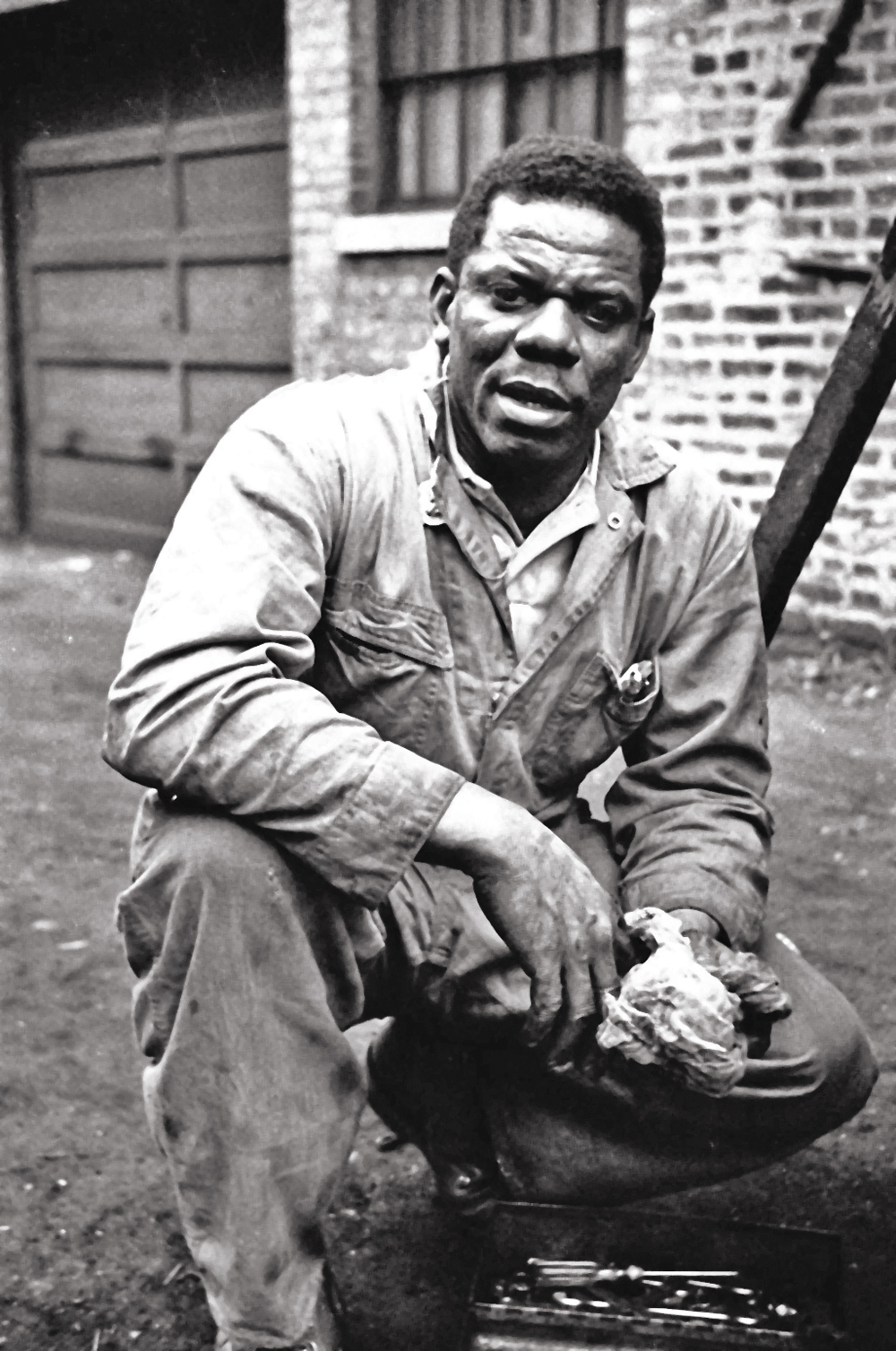
Bill at Chester's Hamburger King, Chicago, Fall 1977. Photo by Michael James from his forthcoming book, Michael Gaylord James' Pictures from the Long Haul.
Pictures from the Long Haul:
Bill at Chester's Hamburger King
A classic Chicago cross-over place, you would find cops, workers, healers and dealers, martial artists, radicals, hot rod mechanics, Cubs coaches and Cub fans, gangbangers and community organizers.
By Michael James / The Rag Blog / May 22, 2013

[In this series, Michael James is sharing images from the past, accompanied by reflections about -- and inspired by -- those images. This photo will be included in his forthcoming book, Michael Gaylord James' Pictures from the Long Haul.]

CHICAGO -- When I tell people about my second favorite restaurant, Hamburger King or Chester's Hamburger King, I affectionately refer to it as a "Japanese greasy spoon." It should be a Chicago landmark.

I started going there in the early 70's, figuring my next moves after Rising Up Angry, the radical organization and newspaper I helped found, came to a close in 1975. The Hamburger King was a major inspiration for me in deciding to open my favorite restaurant, the Heartland Cafe.

Everyone was welcome at Chester's and made to feel good. It was a place to drink coffee, read the paper, eat inexpensive and tasty grub, and run into people. A classic Chicago cross-over place, you would find cops, workers, healers and dealers, martial artists, radicals, hot rod mechanics, Cubs coaches and Cub fans, gangbangers and community organizers -- white people, Latinos, Blacks, Japanese, and Native Americans.

There was Betty the server who always smiled and seemed on top of the needs of a lot of folks at the very same time. And there were Chester, Roland, and Bill, all Japanese guys who had been in the internment camps in California.

Bill was one of the first people I remember telling me about the camps that put another scar on America's face during World War II. He would set me up at a back table where I would eat, read the Chicago papers, write notes, drink coffee, think, and hold court. Bill 's daughter was out west working on PhD's. In November of 1977 he joined the crew for Thanksgiving dinner at the Heartland Cafe.

Hamburger King is located on Sheffield at Clark and Newport, next door to the Nisei Tap. Plates of food --  egg foo yung, yat ka mein, chili mac, and burgers -- would find their way through a back door by the kitchen into the Tap for the drinkers and pool shooters. You had to go through the small kitchen to get to the bathroom. Going back there gave me a good look at the workings of a restaurant kitchen.

The same building also housed the Chicago Women's Health Center and was home to all kinds of body workers -- naprapaths, chiropractors, and massage therapists. There was another bar downstairs, a drugstore, and a resale shop on Newport where a woman sold me four folding chairs from the bleachers at Wrigley Field.

I met many people at Chester's, including the Moors family. One of the brothers had a band that played at the Rising Up Angry "Peoples' Dances." His brother Trooper, now passed, got sent to Sandstone Federal Prison in Minnesota on a drug beef. I took a trip to the North Country through snow and pine trees to visit him.

The big thing for me coming out of Hamburger King was when I told Jack Bornoff that I wanted to open a restaurant, a hangout and community center kind of place. A building we had looked at on Belmont was too expensive. Jack said: "I know a place: Lackey's Steak House in Rogers Park."

Gene Lackey bought steaks and lobster at the old Jewell on Morse Avenue and sold them out of a little kitchen while bluegrass emanated from a small stage in what is now the Heartland's west dining room. Katy Hogan, Stormy Brown, and I went to check it out. Katy -- being a Mundel-­bundle as the girls of Mundelein College were called, knew Lackey's.

The sun came out. A rainbow appeared, as if a message from the Gods. And we were standing on a big cement slab, perfect for an outdoor café, of which there were virtually none in Chicago at the time.

And the Red Line trains -- both A and B -- all stopped at the Morse-­Lunt El stop. The three of us agreed to do it! Lackeys became the home of the Heartland Café. On May 1, 1976, we skipped attending any May Day events, opting instead to work on our new joint.

And wouldn't you know it. Our new neighbor next door in what is now the Heartland Building was Roy Kawaguchi who owned and ran Roy's Bar. Roy had also been in the internment camps, as had his brother who owned Gabby's, a bar two blocks south on Glenwood next to the old electrical station that is now Life Line Theater.

I've tracked Roy's bar back to the 1930's when it was the Rogers Park Yacht Club, then the 7006 Club, Hamm's Tap, Roy's, and now the Heartland's Red Line Tap. The music booker for the RLT is Brettly Kawaguchi, son of Roy, just a little squirt when we showed up.

Over the past 36 years I've returned to Hamburger King a few times a year. Last fall I took a Russian journalist, who did a Chicago travel piece for MIR Magazine on "my Chicago." While driving around and telling stories I took her and the photographer to places I go -- in Rogers Park, the Paradise bathhouse, and shooting locations of movies I've been in (e.g. Stony Island, Code of Silence, The Package, The Fugitive, etc). And we went to Chester's, run for years now by a Korean woman named Sue.

More recently, when on a dropping-off-a-guitar-for-repair errand with my son Cadien, we headed over to Sheffield, Newport and Clark. I about had a heart attack. The place was closed, the windows covered. I acted out: "No, no, oh no." But on closer inspection I was revived, finding a sign that said: "Closed for Remodeling."

A couple of weeks later we went to pick up the guitar and swung by again. This time Hamburger King was open. But it was different: crisper with fresh paint and other "improvements". There was a Mexican grill man I recognized, but no Sue and the waitress was new. In mid-­afternoon the place was pretty empty. The waitress introduced me to the new owner, a Korean fellow.

The egg foo young with rice and gravy was still cheap, humongous, and very good. I talked with the new owner and told him of the inspirational role the place played for me in starting the Heartland.

I asked him where he lived. He said "Northbrook." I said "Northbrook?" and suggested he move to the neighborhood, be close to his place, feel the beat of the city 24-7. I don't think he got that. But I wished him well and thanked him for being open.

[Michael James is a former SDS national officer, the founder of Rising Up Angry, co-founder of Chicago's Heartland Café (1976 and still going), and co-host of the Saturday morning (9-10 a.m. CDT) Live from the Heartland radio show, here and on YouTube. He is reachable by one and all at michael@heartlandcafe.com. Find more articles by Michael James on The Rag Blog.]

The Rag Blog

[+/-] Read More...

21 May 2013

Alan Waldman : ‘My Hero’ is Droll Britcom About Alien Superhero Adapting to English Town Life

 
Waldman's film and TV
treasures you may have missed:
A very funny cast supports comic laffmasters Ardal O’Hanlon and James Dreyfus in 51 highly original episodes.
By Alan Waldman / The Rag Blog / May 21, 2013

[In his weekly column, Alan Waldman reviews some of his favorite films and TV series that readers may have missed, including TV dramas, mysteries, and comedies from Canada, England, Ireland, and Scotland. Most are available on DVD and/or Netflix, and some episodes are on YouTube.]

Two of the very, very funniest characters in British TV comedies of the past quarter-century were Ardal O'Hanlon as Father Dougal in Father Ted and James Dreyfus as Officer Goody in The Thin Blue Line. I have reviewed both of these side-splitting series in previous Rag Blog columns and have recommended them most enthusiastically, as I do their highly amusing 2000-2006 series My Hero.

In the first five My Hero seasons, O’Hanlon (replaced by Dreyfus in the sixth) plays the costumed superhero Thermoman from the planet Ultron who flies around the earth putting out volcanoes and repairing other disasters.

Assuming the Earth body of health-food-store owner George Sunday, he marries local girl Janet Dawkins and struggles to fit into society in the fictional English town of Northolt, but his unfamiliarity with human life leads to many humorous misunderstandings.

The series was very popular for its first 43 episodes, but after the beloved O’Hanlon left, the audience halved for the final eight -- although I just watched these Dreyfus episodes on YouTube and found them very funny. To help you judge the two performances, here is an O’Hanlon episode from early in season one, and here is a great one from the final season where Dreyfus pretends to be a cat.

The actor change is explained thusly: George lost his Earth body in a poker game and it was replaced by Dreyfus’s.

Several of the big joys of My Hero come from the nutty supporting characters. Geraldine McNulty is priceless as sadistic, miserable, supremely unattractive medical receptionist Mrs. Raven, who eventually gets into a wonderfully warped relationship with Ultron exile and Brooklyn Restaurateur Arnie (Lou Hirsch).

Janet and George’s neighbor Tyler (Philip Whitchurch) is a completely bonkers Liverpudlian drug casualty who thinks he visits other planets. Hugh Dennis is a scream as shallow, arrogant buffoon Dr. Piers Crispin, the employer of Janet (Emily Joyce) and Mrs. Raven. More comedy comes from Janet’s wrangling parents (Tim Wylton and Lill Roughley).

The series has a lot of fun with special effects, usually illustrating Thermoman’s powers. Late in the series, George and Janet have two children who can speak from birth, and their superpowers are also conveyed via special effects.

Unlike most Britcoms, where all episodes are penned by the original writer, My Hero takes the American approach of using a team of writers. One of the lead scribes is Paul Mayhew Archer, who was one of the two genius creators of the sublime Britcom The Vicar of Dibley.

The first two seasons of My Hero are on Netflix, and all 51 episodes can be enjoyed on YouTube.

[Oregon writer and Houston native Alan Waldman holds a B.A. in theater arts from Brandeis University and has worked as an editor at The Hollywood Reporter and Honolulu magazine. Read more of Alan Waldman's articles on The Rag Blog.]

The Rag Blog

[+/-] Read More...

BOOKS / Ron Jacobs : Albert Camus and the Liberal Dilemma

Algerian Chronicles:
Albert Camus and the liberal dilemma
These writings do much toward describing the plight of the Algerian people, but suffer from an inability to acknowledge, much less examine, the root cause for their situation.
By Ron Jacobs / The Rag Blog / May 21, 2013

[Algerian Chronicles by Albert Camus (2013: Belknap Press); Hardcover; 240 pp; $21.95.]

Albert Camus is arguably one of the greatest writers of the twentieth century. His relatively short life is well chronicled and the fodder for multiple conversations in university literature classes. His novels and essays raise fundamental questions about life in a world where life can easily be seen to mean absolutely nothing.

Like Jean Paul Sartre -- another writer with whom Camus is often compared and contrasted -- Camus' search for meaning in a world rendered meaningless strikes a chord in every human, especially those who do not seek easy answers. The conclusion these men reached was that it is up to us to provide our own meaning.

It has always been a curiosity, then, why Camus had such a difficult time understanding the desire of the Algerians to create a meaning to their lives that required overthrowing the French colonialists. His understanding that human freedom was perhaps the greatest quality humanity possessed seemed to stop short of recognizing the denial of that freedom under colonialism.

This shortsightedness led Camus to justify situations in a manner that remind this reviewer of Rube Goldberg's inventions, only without the result desired. In other words, explanations full of loops and turns but without even the conclusive ending Goldberg’s inventions achieved.

So, it was with just such a hope for clarification that I picked up Camus' recently published (in English) Algerian Chronicles. Perhaps these writings would reveal some clarity to his position not found previously. Unfortunately, I was disappointed. While Camus certainly goes further in explaining his position (or perhaps lack of a position would be a better phrasing) regarding the situation of the French vis-a-vis their occupation of Algeria, that position is no less muddleheaded than any explanation previously published.

This collection of writings includes a number of articles and essays Camus wrote for French journals. It also includes some rather extensive reporting on the situation of the colonized Algerians. These writings do much toward describing the plight of these people, but suffer from an inability to acknowledge, much less examine, the root cause for their situation.

After citing example after example of colonial neglect and abuse, Camus still fails to point the finger at the cause of these failings. My visceral reaction is simply, how can he not understand that these examples are not failings of colonialism, but exactly how colonialism works. The psychological underpinnings are fundamental to the dynamic, affecting both the colonized and the colonizer.

In what is best described as the liberal dilemma, by refusing to accept that history is as important as the present when examining colonial and imperial situations, Camus’ writing consistently falls short in its explanation of why Algeria and France found themselves in conflict in the years of the Algerian liberation struggle.

In the historical vacuum that Camus places himself in, he ends up accepting the facts of French colonialism and oppression as immutable. Furthermore, he seems to reject the idea that the Algerians should have any say in their own future unless it is on terms determined mostly by the French colonizers.

As always, Camus’ writing shines. Reading these relatively short articles prove his ability to evoke emotion and make his argument eloquently. Unbeknownst at the time of their writing, Camus’ writings about the French colonization of Algeria Camus are also chronicling its end. His personal laments regarding that demise represent the thinking of those who either cannot or will not acknowledge that the brutality and theft that all too often defines settler colonialism does not appear able to end without violence and tragedy.

Parallels to the situation of Algeria abound in modern history. One could easily argue that one of today’s still existing examples of this dynamic is found in Palestine. The Palestinians are colonized in their own lands and their struggle to liberate those lands is often violent, as is the repression of that struggle. Most of the solutions presented are those created in Washington and Tel Aviv, much like many of the solutions to Algeria’s situation were created in Paris.

The idea that Palestinians deserve the right to determine the nature of their struggle is still not a popular one in imperial capitals. Neither was the idea that the Algerians (or the Vietnamese, to name another people struggling for their liberation) deserved that right in the time of their struggle.

[Rag Blog contributor Ron Jacobs is the author of The Way The Wind Blew: A History of the Weather Underground. He recently released a collection of essays and musings titled Tripping Through the American Night. His novels, The Co-Conspirator's Tale, and Short Order Frame Up will be republished by Fomite in April 2013 along with the third novel in the series All the Sinners Saints. Ron Jacobs can be reached at ronj1955@gmail.com. Find more articles by Ron Jacobs on The Rag Blog.]

The Rag Blog

[+/-] Read More...

Lamar W. Hankins : Texas Atty. Gen. Greg Abbott's 'Demagoduery'

Kountze cheerleaders. Screen grab from ABC News. Image from Austinist.com.
Gimme a 'G':
Texas Atty. Gen. Abbott’s 'demagoduery'
It is beyond conjecture or opinion: the Kountze cheerleader banners expressing religious views are government speech.
By Lamar W. Hankins / The Rag Blog / May 21, 2013

Sometimes the marvelous English language with its quarter of a million words fails to capture adequately in one word the character of a person or action. Such is the case with the behavior of Texas Attorney General Greg Abbott as he uses his political position to curry favor with the religious right and further develop his obsequious relationship with that group.

So I have invented a new word to describe this behavior: demagoduery.

Demagoduery occurs when someone, usually a politician, publicly announces his support for government promotion of religion (for example, posting the Ten Commandments in government buildings); when he advocates that the government sponsor religious exercise (particularly praying at government meetings); when he invokes his belief in God as part of his political character; when he calls on God from his public position to fix something that’s not working right (like when we have a drought and he asks God for rain); when he engages in all manner of conspicuous religiosity; and when he exaggerates or distorts the legal precedents for government entanglement with religion.

Abbott’s latest bit of demagoduery is his support for the Kountze, Texas, cheerleaders, who in their official capacities as school cheerleaders at football games, like to promote their religion (it’s Christian by the way) by writing Bible verses on large signs that they hold up before games and which the football team bursts through when the players run out on the field. Some of the signs have read:
  • “But thanks be to God, which gives us Victory through our Lord Jesus Christ - I Cor. 15:57”
  • “If God is for us who can be against us? - Romans 8:31”
  • “I press on toward the goal to win the prize for which God has called me in Christ Jesus - Philippians 3:14”
  • “I can do all things through Christ who strengthens me - Philippians 4:13”
Last fall, when the Freedom From Religion Foundation (FFRF), a non-profit educational and advocacy organization, received a complaint from a man who had attended one of the Kountze ISD football games and was offended by the signs, the FFRF pointed out to the superintendent of schools of the Kountze ISD that the cheerleaders were official representatives of the high school and they were promoting religion at an official school-sponsored event with the Bible verses.

The superintendent then sought legal advice from a law firm. He was told that such promotion of religion was a violation of court decisions related to the separation of church and state. He ordered that the Bible-verse promoting at football games cease. The cheerleaders, through their parents, sued the school district in state court and obtained an injunction that would allow the promotion of religion at football games to continue.

The case was scheduled for trial in June, but under pressure from the community, and with the support of Governor Rick Perry and Attorney General Abbott, the superintendent agreed to rescind his order prohibiting the Bible verses from being displayed by the cheerleaders at football games.

State District Judge Steven Thomas, appointed to his position in 2011 by Governor Perry, then granted summary judgment since there was no dispute between the parties, and issued a written opinion.

Thomas’s decree cites no law or court decisions on which the order is based. It simply declares that “the religious messages expressed on run-through banners have not created, and will not create, an establishment of religion in the Kountze community” (a statement that demonstrates a lack of understanding of First Amendment jurisprudence); that the religious messages on the banners displayed during the 2012 football season “were constitutionally permissible”; that “Neither the Establishment Clause nor any other law prohibits cheerleaders from using religious-themed banners at school sporting events”; and that Kountze I.S.D. is not required by the Establishment Clause nor any other law “to prohibit the inclusion of religious-themed banners at school sporting events.”

Texas Attorney General Greg Abbott jumped at the opportunity to engage in demagoduery by issuing the following statement:
This is a victory for religious liberties and for high school cheerleaders who stood up to powerful forces that tried to silence their voices. The Freedom From Religion Foundation was wrong in trying to bully Kountze ISD into prohibiting the cheerleaders from displaying banners with religious messages. Our Constitution has never demanded that students check their religious beliefs at the schoolhouse door. Students’ ability to express their religious views adds to the diversity of thought that has made this country so strong. The Kountze Cheerleaders are heroes who fought for principles, and won!
Of course, no one tried to silence the voices of the Kountze cheerleaders as individual citizens. But some people recognized that the cheerleaders were using their official positions as representatives of the Kountze ISD to promote their personal religious views, which had the effect of making them the Kountze ISD’s views.

These actions appear to violate a previous Supreme Court ruling. The actions place the government in the position of favoring a particular religion over other religions and over no religion. Any student not representing the school district in an official capacity is free to display religious-themed banners at football games, though it might seem to some people that a football game is a strange place to debate religion in all its diversity.

In fact, the context in which speech occurs is relevant to judging its character. As the FFRF has pointed out, if the context of the speech “would lead an objective observer to believe a public school is endorsing the speech,” the Supreme Court has held that the speech “is not properly characterized as ‘private’ speech.” (See Santa Fe I. S. D. v. Doe, decided in 2000.)

And the Court’s position holds even if the speech is completely student-initiated and student-led, as was the case regarding the football banners at Kountze ISD last year.

Greg Abbott (and the Ten Commandments).
The context suggests that the school is endorsing the religious views expressed, rather than maintaining neutrality toward religion as the Constitution requires.

The cheerleaders have official positions with the school district; they wear official school uniforms; they are under the supervision of school officials; the football games are an official school-sponsored activity; the stadium in which the banners were displayed by the cheerleaders is owned and operated by the Kountze ISD; the costs of the event are paid for by the Kountze ISD; the stadium is filled with indicia of the Kountze ISD (its name, the school’s mascot, the school’s colors, the school insignia, etc.); the school district controls who may have access to the playing field.

And now the Kountze ISD, in its pleadings to the district court, officially endorses the activity of the cheerleaders in promoting religious views in this context.

As FFRF pointed out in its Amicus Brief filed with the court,
The district controls everything about this message including: (1) where the message is presented; (2) who presents the message; (3) what the students holding the message are wearing; (4) the property where the message is delivered; and (5) the event at which the message is presented. The cheerleading squad represents and speaks for all members of that team, the football team, and the student body.
In Santa Fe v. Doe, the Supreme Court found that similar speech was government speech in a context remarkably similar to the context found in Kountze. If the viewing audience would reasonably perceive the religious messages promoted by the cheerleaders as representing the views of the student body “delivered with the approval of the school administration,” then the speech will be seen by the court as government speech.

It is beyond conjecture or opinion: the Kountze cheerleader banners expressing religious views are government speech. The First Amendment’s Establishment Clause does not permit the government to express religious views. Even Attorney General Abbott should know that.

But the Attorney General wants the citizens to believe that the religious liberty of the cheerleaders is being infringed, although he knows that those same cheerleaders are free to display religious banners at any time they are not representing the Kountze ISD in an official capacity.

 If the banners were the cheerleaders' private speech, there would be no conflict with the Constitution. The cheerleaders are engaging in religious speech in the wrong context, but it does not serve the Attorney General’s demagoduery to acknowledge that fact.

As the FFRF pointed out in its Amicus brief:
The banners with biblical quotations are an affront to non-Christians and non-religious students, faculty, and members of the school community. Even supporters of the banners have acknowledged to national news media that they could be upsetting to Jewish students... Students on the cheerleading squad and the football team may be offended by the exclusionary message because they are not Christian or religious.

Given the elite status that football has in the State of Texas, what dissenter on the squad or team would dare speak out? Allowing the religious messages on these banners forces those students to violate their rights of conscience, or else to "forfeit [their]... rights and benefits at the price of resisting conformance to state-sponsored religious practice." (Citing Lee v. Weisman, a 1992 Supreme Court case.)
If Attorney General Abbott were really representing the Constitution and the interests of all Texans, he would acknowledge that the cheerleaders at Kountze football games engaged in school-sponsored speech -- a kind of government-promoted religious speech that offends civil behavior and violates the leading Supreme Court interpretations of the Establishment Clause of the First Amendment as applied to public schools. But Abbott will never do that.

The attraction of demagoduery is just too strong for a sanctimonious, self-promoting politician like him.

[Lamar W. Hankins, a former San Marcos, Texas, city attorney, is also a columnist for the San Marcos Mercury. This article © Freethought San Marcos, Lamar W. Hankins. Read more articles by Lamar W. Hankins on The Rag Blog.]

The Rag Blog

[+/-] Read More...

20 May 2013

Harry Targ : The REAL Scandal at the IRS

"Can't make 'em see the light? Make 'em feel the heat" -- Hugh Fike, coordinator of the Heritage Society for America's "Sentinel" program.
The IRS 'scandal' is not
what opportunists claim it is
If the Internal Revenue Service is to be criticized, the attacks should be leveled at the government’s inadequate scrutiny of political lobbying groups who are granted tax exempt status
By Harry Targ / The Rag Blog / May 20, 2013
"Heritage Action for America is a unique combination of top-notch conservative policy analysis, a widely respected governmental relations team and dedicated grassroots activists that advance conservative policy.

"...As a 501(c)(4) organization, Heritage Action for America allows unprecedented coordination and communication with concerned citizens who want to be part of their national dialogue. We speak directly to the American people and help them break through the establishment in Washington." -- from Heritage Action for America website.
According to the Internal Revenue Code organizations may apply and be eligible for tax exempt status under Section 501(c)(4) if they engage primarily in “social welfare activities.” Contributors to 501(c)(4) organizations need not disclose their names.

In a recent website update on legislative issues being debated in the House of Representatives, Heritage Action for America, a 501(c)(4) advocated the repeal of the Affordable Care Act; endorsed the Full Faith and Credit Act, which would prioritize debt payment before financing federal spending; and supported legislation, the Preventing Greater Uncertainty in Labor-Management Relations Act, suspending the National Labor Relations Board from acting until such time as the Senate approves appointments to the Board.

Indiana Congressman Todd Rokita (4th Congressional District) wrote his constituents on May 17, 2013 that “...the IRS had specifically targeted legally-established non-profit conservative groups by singling them out for extra scrutiny when they applied for tax-exempt status.”

Heritage Action for America assigned Rokita a grade of 79 (out of 100) for his legislative record in the last session of Congress, not far behind long-time right-winger Dan Burton and new Indiana governor Mike Pence. Conservative former Democratic Congressman, now Senator, Joe Donnelly received a score of 23.

The principle of granting tax exemptions for groups that engage in social welfare was introduced in the Revenue Act of 1913 and revised in the tax code of the 1950s. Once groups are declared eligible, such as the Heritage Foundation’s Heritage Action for America, donors can contribute anonymously. Meanwhile the organizations so approved can advertise on television, radio, and the print media against programs advocated by those with different political orientations.

Ironically groups like Heritage Action for America define their political advocacy for tax purposes as social welfare. And, most important, organizations supporting the candidacy of right-wing Republicans such as Todd Rokita are receiving tax exemptions.

In short, Rokita has a high Heritage Action for America favorability score for opposing affordable health care for most Americans; federal programs for childhood nutrition, education, and emergency health services for the elderly; and government protection for worker rights.

If the Internal Revenue Service is to be criticized, the attacks should be leveled at the government’s inadequate scrutiny of political lobbying groups who are granted tax exempt status contrary to the intention of the law.

Those of us who are concerned about the undue intrusion of big money in politics should be working to insist that the tax code be applied as it was intended so that politicians like Rokita cannot get away with railing against “big government” while they benefit from how it has been applied to them.

[Harry Targ is a professor of political science at Purdue University and is a member of the National Executive Committee of the Committees of Correspondence for Democracy and Socialism. He lives in West Lafayette, Indiana, and blogs at Diary of a Heartland Radical. Read more of Harry Targ's articles on The Rag Blog.]

The Rag Blog

[+/-] Read More...

Bob Feldman : Texas Governors Bush and Perry, and Their Network of the Ultra-Rich, 1996-2011

Texas Gov. Rick Perry with then President (and former Texas Governor) George W. Bush at a 2002 campaign event in Dallas. On the left is Texas Sen. John Cornyn. Photo by Larry Downing / Reuters.
The hidden history of Texas
Conclusion: 1996-2011/1 -- Bush, Perry, and their network of Texas ultra-rich
By Bob Feldman / The Rag Blog / May 20, 2013

[This is the first section of the conclusion to Bob Feldman's Rag Blog series on the hidden history of Texas.]

When George W. Bush became the Republican Governor of Texas, “he arrived indebted to dozens of industries and wealthy patrons” and “repaid some of his supporters with choice political appointments,” according to the Center for Public Integrity’s The Buying of the President 2000.

The same book indicated what the political situation was like in Texas state politics in 2000 -- before Texas’s governor moved into the White House in 2001 after receiving fewer popular votes than the Democratic Party candidate in the 2000 U.S. presidential election:
One of the most prestigious political appointments is a seat on the University of Texas board of Regents. The board is filled with Bush’s top-dollar donors. The chair of the UT Regents is Donald Evans, Bush’s old friend and longtime fund-raiser who, as the finance chairman for Bush’s presidential bid, has overseen the campaign’s record-shattering fund-raising drive. Evans is the chief executive officer of Tom Brown, Inc., an oil and gas company based in Midland, Texas .

In 1989, Bush joined the board as an outside director. He received $12,000 a year plus stock options for attending several meetings and participating in conference calls... Shortly after he was elected governor of Texas, Bush sold his Tom Brown holdings for a profit of $297,550.

Another regent and top Bush patron is A.R. `Tony’ Sanchez, the chairman and chief executive of Sanchez-O’Brien Oil and Gas Corporation... Sanchez and his mother also own a controlling stake in International Bancshares Corporation, the holding company of International Bank of Commerce, a Texas banking chain founded by his father in 1966. Over [George W.] Bush’s career, Sanchez, members of his family, and employees of his companies have given him at least $230,150, making them his No. 2 career patron…

Bush owed few people more than Richard Rainwater, the Fort Worth financier... Rainwater launched an investment company in 1994, Crescent Real Estate Equities Company... In 1997, Bush backed a plan to cut state property taxes that would have saved Crescent some $2.5 million in state taxes... Later that year,...Bush signed a bill into law that produced a $10 million windfall for Crescent... Dallas taxpayers were to foot most of the bill for the new sports arena…Rainwater, through Crescent, bought a 12 percent stake in the Mavericks. Under the purchase agreement, Crescent will get $10 million when the arena is completed…

The Texas Teachers’ Retirement System...sold two office buildings and a mortgage on a third to Crescent in 1996 and 1997 at a $70.4 million loss... At the time of at least one of the sales, Bush owned about $100,000 worth of Crescent stock... The University of Texas Investment Management Company [UTIMCO]...has steered close to $1.7 billion of its assets into private investments; a third of that money has gone into funds run either by...[UTIMCO Chairman Hicks]’s business partner or by Bush patrons...

Industries that have provided the bulk of Bush’s campaign contributions have gotten his help in a variety of endeavors, from staving off pesky environmental regulations and shielding themselves from consumer lawsuits to driving off meddlesome investigators... According to a study by Public Research Works, Bush raised $566,000 from...polluters for his two gubernatorial campaigns. And from March 4, 1999 to March 31, 1999 Bush raised $316,300... They included: Enron ( Bush’s No. 1 career patron); Vinson & Elkins (Bush’s No. 3 career patron), a law firm that represents Enron and Alcoa, a...polluter; and companies owned by the Bass family (Bush’s No. 5 career patron).
And, coincidentally, some of the same ultra-rich folks who bankrolled former Texas governor Bush’s campaigns in the 1990s have apparently been donating a lot of money in the 21st-century to fund the campaigns of the current governor of Texas, former 2012 GOP presidential primaries candidate Rick Perry.

Between 2001 and Oct. 23, 2010, for example, Perry (a former U.S. Air Force officer who is the son of former Haskell County Commissioner Ray Perry) received $337,027 in campaign contributions from Lee Bass, $100,000 in campaign contributions from Sid Bas, and 265,000 in campaign contributions from Ray Hunt, according to the Texans for Public Justice website.

The same website also recalled that “as Texas' longest-serving governor, Rick Perry raised $98.9 million from 2001 through Oct. 23, 2010,” and that “Perry raised almost $49 million (or 50 percent of this money) from 193 mega donors who gave him $100,000 or more.”

Between 1990 and 2000, the number of people who lived in Austin increased from 465,622 to 656,562; and the number of people who lived in the Austin-Round Rock metropolitan area increased from 846,227 to 1,249,763 during the same period.

According to the “Forty Acres and a Shul: `It’s Easy as Dell’” essay by Cathy Schechter that appeared in Lone Stars of David: the Jews of Texas, between 1990 and 2000,  Austin ’s Jewish-affiliated population also increased from 5,000 “to more than 10,000," and “by 2002, the American Jewish Yearbook estimated the city’s Jewish population at 13,500.”

But “the appearance of young `Dellionaire’ Jews who made millions in the brave new world of high-technology took the mellow Austin Jewish community by surprise.” Yet by 2007, Texas billionaire Michael Dell -- with an estimated personal wealth that year of $17.2 billion -- was the wealthiest ultra-rich person in Texas .

But in 2007 Robert Bass was still worth $5.5 billion, Ray Hunt was worth $4 billion, Sid and Lee Bass were worth $3 billion, and Ed Bass was worth $2.5 billion, according to Bryan Burrough's The Big Rich. The same book also noted that in 2007, coincidentally, “Hunt Oil received a lucrative concession to drill in northern Iraq,” and “Sid Bass, whose family, along with the Hunts, ranked among Bush’s largest financial backers, was photographed alongside the president, Laura Bush, and the queen of England...”

[Bob Feldman is an East Coast-based writer-activist and a former member of the Columbia SDS Steering Committee of the late 1960s. Read more articles by Bob Feldman on The Rag Blog.]

The Rag Blog

[+/-] Read More...

16 May 2013

Robert Jensen : The Collapse of Journalism

Graphic treatment by James Retherford / The Rag Blog.
The collapse of journalism and 
the journalism of collapse:
From royal, to prophetic, to apocalyptic
When we strip away supernatural claims and delusions of grandeur, we can understand the prophetic as the calling out of injustice, the willingness not only to confront the abuses of the powerful but to acknowledge our own complicity.
By Robert Jensen / The Rag Blog / May 16, 2013
Listen to the podcast of Thorne Dreyer's May 10, 2013, Rag Radio interview with Bob Jensen at the Internet Archive. Rag Radio, a syndicated radio show, is first broadcast -- and streamed live -- Fridays from 2-3 p.m. on KOOP 91.7-FM in Austin, Texas.
For those who believe that a robust public-affairs journalism is essential for a society striving to be democratic, the 21st century has been characterized by bad news that keeps getting worse.

Whatever one’s evaluation of traditional advertising-supported news media (and I have been among its critics; more on that later), the unraveling of that business model has left us with fewer professional journalists who are being paid a living wage to do original reporting. It’s unrealistic to imagine that journalism can flourish without journalists who have the time and resources to do journalism.

For those who care about a robust human presence on the planet, the 21st century has been characterized by really bad news that keeps getting really, really worse.

Whatever one’s evaluation of high-energy/high-technology civilization (and I have been among its critics; more on that later), it’s now clear that we are hitting physical limits; we cannot expect to maintain contemporary levels of consumption that draw down the ecological capital of the planet at rates dramatically beyond replacement levels. It's unrealistic to imagine that we can go on treating the planet as nothing more than a mine from which we extract and a landfill into which we dump.

We have no choice but to deal with the collapse of journalism, but we also should recognize the need for a journalism of collapse. Everyone understands that economic changes are forcing a refashioning of the journalism profession. It’s long past time for everyone to pay attention to how multiple, cascading ecological crises should be changing professional journalism’s mission in even more dramatic fashion.

It’s time for an apocalyptic journalism (that takes some explaining; a lot more on that later).


The basics of journalism: Ideals and limitations

With the rapid expansion of journalistic-like material on the Internet, it’s especially crucial to define “real” journalism. In a democratic system, ideally journalism is a critical, independent source of information, analysis, and the varied opinions needed by citizens who want to play a meaningful role in the formation of public policy.

The key terms are “critical” and “independent” -- to fulfill the promise of a free press, journalists must be willing to critique not only specific people and policies, but the systems out of which they emerge, and they must be as free as possible from constraining influences, both overt and subtle.

Also included in that definition of journalism is an understanding of democracy -- “a meaningful role in the formation of public policy” -- as more than just lining up to vote in elections that offer competing sets of elites who represent roughly similar programs. Meaningful democracy involves meaningful participation.

This discussion will focus on what is typically called mainstream journalism, the corporate-commercial news media. These are the journalists who work for daily newspapers, broadcast and cable television, and the corporately owned platforms on the internet and other digital devices.

Although there are many types of independent and alternative journalism of varying quality, the vast majority of Americans continue to receive the vast majority of their news from these mainstream sources, which are almost always organized as large corporations and funded primarily by advertising.

Right-wing politicians and commentators sometimes refer to the mainstream media as the “lamestream,” implying that journalists are comically incompetent and incapable of providing an accurate account of the world, likely due to a lack of understanding of conservative people and their ideas. While many elite journalists may be dismissive of the cultural values of conservatives, this critique ignores the key questions about journalism’s relationship to power.

Focusing on the cultural politics of individual reporters and editors -- pointing out that they tend to be less religious and more supportive of gay and women’s rights than the general public, for example -- diverts attention from more crucial questions about how the institutional politics of corporate owners and managers shapes the news and keeps mainstream journalism within a centrist/right conventional wisdom.

The managers of commercial news organizations in the United States typically reject that claim by citing the unbreachable “firewall” between the journalistic and the business sides of the operation, which is supposed to allow journalists to pursue any story without interference from the corporate front office.

This exchange I had with a newspaper editor captures the ideology: After listening to my summary of this critique of the U.S. commercial news media system, this editor (let’s call him Joe) told me proudly: “No one from corporate headquarters has ever called me to tell me what to run in my paper.” I asked Joe if it were possible that he simply had internalized the value system of the folks who run the corporation (and, by extension, the folks who run most of the world), and therefore they never needed to give him direct instructions.

He rejected that, reasserting his independence from any force outside his newsroom.

I countered: “Let’s say, for the purposes of discussion, that you and I were equally capable journalists in terms of professional skills, that we were both reasonable candidates for the job of editor-in-chief that you hold. If we had both applied for the job, do you think your corporate bosses would have ever considered me for the position, given my politics? Would I, for even a second, have been seen by them to be a viable candidate for the job?”

Joe’s politics are pretty conventional, well within the range of mainstream Republicans and Democrats -- he supports big business and U.S. supremacy in global politics and economics. I’m a critic of capitalism and U.S. foreign policy. On some political issues, Joe and I would agree, but we diverge sharply on these core questions of the nature of the economy and the state.

Joe pondered my question and conceded that I was right, that his bosses would never hire someone with my politics, no matter how qualified, to run one of their newspapers. The conversation trailed off, and we parted without resolving our differences.

I would like to think my critique at least got Joe to question his platitudes, but I never saw any evidence of that. In his subsequent writing and public comments that I read and heard, Joe continued to assert that a news media system dominated by for-profit corporations was the best way to produce the critical, independent journalism that citizens in a democracy needed.

Because he was in a position of some privilege and status, nothing compelled Joe to respond to my challenge.

Partly as a result of many such unproductive conversations, I continue to search for new ways to present a critique of mainstream journalism that might break through that ideological wall. In addition to thinking about alternatives to this traditional business model, we should confront the limitations of the corresponding professional model, with its status-quo-supportive ideology of neutrality, balance, and objectivity.

Can we create conditions under which journalism -- deeply critical and truly independent -- can flourish in these trying times?

In this essay I want to try out theological concepts of the royal, prophetic, and apocalyptic traditions. Though journalism is a secular institution, religion can provide a helpful vocabulary. The use of these terms is not meant to imply support for any particular religious tradition, or for religion more generally, but only recognizes that the fundamental struggles of human history play out in religious and secular settings, and we can learn from all of that history.

With a focus on the United States, I’ll draw on the concepts as they are understood in the dominant U.S. tradition of Judaism and Christianity.


Royal journalism

Most of today’s mainstream corporate-commercial journalism -- the work done by people such as Joe -- is royal journalism, using the term “royal” not to describe a specific form of executive power but as a description of a system that centralizes authority and marginalizes the needs of ordinary people.

The royal tradition describes ancient Israel, the Roman empire, European monarchs, or contemporary America -- societies in which those with concentrated wealth and power can ignore the needs of the bulk of the population, societies where the wealthy and powerful offer platitudes about their beneficence as they pursue policies to enrich themselves.

In his books The Prophetic Imagination and The Practice of Prophetic Imagination, theologian Walter Brueggemann points out that this royal consciousness took hold after ancient Israel sank into disarray, when Solomon overturned Moses -- affluence, oppressive social policy, and static religion replaced a God of liberation with one used to serve an empire.

This consciousness develops not only in top leaders but throughout the privileged sectors, often filtering down to a wider public that accepts royal power. Brueggemann labels this a false consciousness: “The royal consciousness leads people to numbness, especially to numbness about death.”

The inclusion of the United States in a list of royalist societies may seem odd, given the democratic traditions of the country, but consider a nation that has been at war for more than a decade, in which economic inequality and the resulting suffering has dramatically deepened for the past four decades, in which climate change denial has increased as the evidence of the threat becomes undeniable. Brueggemann describes such a culture as one that is “competent to implement almost anything and to imagine almost nothing.”

Almost all mainstream corporate-commercial journalism is, in this sense, royal journalism. It is journalism without the imagination needed to move outside the framework created by the dominant systems of power. CNN, MSNBC, and FOX News all practice royal journalism. The New York Times is ground zero for royal journalism.

Marking these institutions as royalist doesn’t mean that no good journalism ever emerges from them, or that they employ no journalists who are capable of challenging royal arrangements. Instead, the term recognizes that these institutions lack the imagination necessary to step outside of the royal consciousness on a regular basis. Over time, they add to the numbness rather than jolt people out of it.

The royal consciousness of our day is defined by unchallengeable commitments to a high-energy/high-technology worldview, within a hierarchical economy, run by an imperial nation-state. These technological, economic, and national fundamentalisms produce a certain kind of story about ourselves, which encourages the belief that we can have anything we want without obligations to other peoples or other living things, and that we deserve this.

Brueggemann argues that this bolsters notions of “U.S. exceptionalism that gives warrant to the usurpatious pursuit of commodities in the name of freedom, at the expense of the neighbor.”

If one believes royal arrangements are just and sustainable, then royal journalism could be defended. If the royal tradition is illegitimate, than a different journalism is necessary.


Prophetic journalism 

Given the multiple crises that existing political, economic, and social systems have generated, the ideals of journalism call for a prophetic journalism. The first step in defending that claim is to remember what real prophets are not: They are not people who predict the future or demand that others follow them in lockstep.

In the Hebrew Bible and Christian New Testament, prophets are the figures who remind the people of the best of the tradition and point out how the people have strayed. In those traditions, using our prophetic imagination and speaking in a prophetic voice requires no special status in society, and no sense of being special. Claiming the prophetic tradition requires only honesty and courage.

When we strip away supernatural claims and delusions of grandeur, we can understand the prophetic as the calling out of injustice, the willingness not only to confront the abuses of the powerful but to acknowledge our own complicity. To speak prophetically requires us first to see honestly -- both how our world is structured by systems that create unjust and unsustainable conditions, and how we who live in the privileged parts of the world are implicated in those systems.

To speak prophetically is to refuse to shrink from what we discover or from our own place in these systems. We must confront the powers that be, and ourselves.

The Hebrew Bible offers us many models. Amos and Hosea, Jeremiah and Isaiah -- all rejected the pursuit of wealth or power and argued for the centrality of kindness and justice. The prophets condemned corrupt leaders but also called out all those privileged people in society who had turned from the demands of justice, which the faith makes central to human life.

In his analysis of these prophets, the scholar and activist Rabbi Abraham Joshua Heschel concluded:
Above all, the prophets remind us of the moral state of a people: Few are guilty, but all are responsible. If we admit that the individual is in some measure conditioned or affected by the spirit of society, an individual’s crime discloses society’s corruption.
Critical of royal consciousness, Brueggemann argues that the task of those speaking prophetically is to “penetrate the numbness in order to face the body of death in which we are caught” and “penetrate despair so that new futures can be believed in and embraced by us.” He encourages preachers to think of themselves as “handler[s] of the prophetic tradition,” a job description that also applies to other intellectual professions, including journalism.

Brueggemann argues that this isn’t about intellectuals imposing their views and values on others, but about being willing to “connect the dots”:
Prophetic preaching does not put people in crisis. Rather it names and makes palpable the crisis already pulsing among us. When the dots are connected, it will require naming the defining sins among us of environmental abuse, neighborly disregard, long-term racism, self-indulgent consumerism, all the staples from those ancient truthtellers translated into our time and place.
None of this requires journalists to advocate for specific politicians, parties, or political programs; we don’t need journalists to become propagandists. Journalists should strive for real independence but not confuse that with an illusory neutrality that traps mainstream journalists within ideological boundaries defined by the powerful.

Again, real independence means the ability to critique not just the worst abuses by the powerful within the systems, but to critique the systems themselves.

This prophetic calling is consistent with the aphorism many journalists claim as a shorthand mission statement: The purpose of journalism is to comfort the afflicted and afflict the comfortable. That phrase focuses on injustice within human societies, but what of the relationship of human beings to the larger living world? How should journalists understand their mission in that arena?


Ecological realities

Let’s put analysis of journalism on hold and think about the larger world in which journalism operates. Journalistic ideals and norms should change as historical conditions change, and today that means facing tough questions about ecological sustainability.

There is considerable evidence to help us evaluate the health of the ecosphere on which our own lives depend, and an honest evaluation of that evidence leads to a disturbing conclusion: Life as we know it is almost over. That is, the high-energy/high-technology life that we in the affluent societies live is a dead-end.

There is a growing realization that we have disrupted planetary forces in ways we cannot control and do not fully understand. We cannot predict the specific times and places where dramatic breakdowns will occur, but we can know that the living system on which we depend is breaking down.

Does that seem histrionic? Excessively alarmist? Look at any crucial measure of the health of the ecosphere in which we live -- groundwater depletion, topsoil loss, chemical contamination, increased toxicity in our own bodies, the number and size of “dead zones” in the oceans, accelerating extinction of species and reduction of bio-diversity -- and the news is bad.

Add to that the mother of all ecological crises -- global warming, climate change, climate disruption -- and it’s clear that we are creating a planet that cannot indefinitely support a large-scale human presence living this culture’s idea of the good life.

We also live in an oil-based world that is rapidly depleting the cheap and easily accessible oil, which means we face a huge reconfiguration of the infrastructure that undergirds our lives. Meanwhile, the desperation to avoid that reconfiguration has brought us to the era of “extreme energy” using even more dangerous and destructive technologies (hydrofracturing, deep-water drilling, mountain-top removal, tar sands extraction) to get at the remaining hydrocarbons.

Where we are heading? Off the rails? Into the wall? Over the cliff? Pick your favorite metaphor. Scientists these days are talking about tipping points and planetary boundaries, about how human activity is pushing the planet beyond its limits.

Recently 22 top scientists in the prestigious journal Nature warned that humans likely are forcing a planetary-scale critical transition “with the potential to transform Earth rapidly and irreversibly into a state unknown in human experience.” That means that “the biological resources we take for granted at present may be subject to rapid and unpredictable transformations within a few human generations.”

That means that we’re in trouble, not in some imaginary science-fiction future, but in our present reality. We can’t pretend all that’s needed is tinkering with existing systems to fix a few environmental problems; significant changes in how we live are required. No matter where any one of us sits in the social and economic hierarchies, there is no escape from the dislocations that will come with such changes.

Money and power might insulate some from the most wrenching consequences of these shifts, but there is no permanent escape. We do not live in stable societies and no longer live on a stable planet. We may feel safe and secure in specific places at specific times, but it’s hard to believe in any safety and security in a collective sense.

In short, we live in apocalyptic times.


Apocalypse

To be clear: Speaking apocalyptically need not be limited to claims that the world will end on a guru’s timetable or according to some allegedly divine plan. Lots of apocalyptic visions -- religious and secular -- offer such certainty, imaging the replacement of a corrupt society by one structured on principles that will redeem humanity (or at least redeem those who sign onto the principles). But this need not be our only understanding of the term.

Most discussions of revelation and apocalypse in contemporary America focus on the Book of Revelation, also known as The Apocalypse of John, the final book of the Christian New Testament. The two terms are synonymous in their original meaning; “revelation” from Latin and “apocalypse” from Greek both mean a lifting of the veil, a disclosure of something hidden from most people, a coming to clarity.

Many scholars interpret the Book of Revelation not as a set of predictions about the future but as a critique of the oppression of the empire of that day, Rome.

To speak apocalyptically, in this tradition, is first and foremost about deepening our understanding of the world, seeing through the obfuscations of people in power. In our propaganda-saturated world (think about the amount of advertising, public relations, and marketing that we are bombarded with daily), coming to that kind of clarity about the nature of the empires of our day is always a struggle, and that notion of revelation is more crucial than ever.

Thinking apocalyptically, coming to this clarity, will force us to confront crises that concentrated wealth and power create, and reflect on our role in these systems. Given the severity of the human assault on the ecosphere, compounded by the suffering and strife within the human family, honest apocalyptic thinking that is firmly grounded in a systematic evaluation of the state of the world is not only sensible but a moral obligation.

Rather than thinking of revelation as divine delivery of a clear message about some fantastic future above, we can engage in an ongoing process of revelation that results from an honest struggle to understand, a process that requires a lot of effort.

Things are bad, systems are failing, and the status quo won’t last forever. Thinking apocalyptically in this fashion demands of us considerable courage and commitment. This process will not produce definitive answers but rather help us identify new directions.

Again, to be very clear: “Apocalypse” in this context does not mean lakes of fire, rivers of blood, or bodies lifted up to heaven. The shift from the prophetic to the apocalyptic can instead mark the point when hope in the viability of existing systems is no longer possible and we must think in dramatically new ways.

Invoking the apocalyptic recognizes the end of something. It’s not about rapture but a rupture severe enough to change the nature of the whole game.


Apocalyptic journalism

The prophetic imagination helps us analyze the historical moment we’re in, but it’s based on an implicit faith that the systems in which we live can be reshaped to stop the worst consequences of the royal consciousness, to shake off that numbness of death in time.

What if that is no longer possible? Then it is time to think about what’s on the other side. “The arc of the moral universe is long, but it bends toward justice,” said Martin Luther King, Jr., one of the more well-known voices in the prophetic tradition. But if the arc is now bending toward a quite different future, a different approach is needed.

Because no one can predict the future, these two approaches are not mutually exclusive; people should not be afraid to think prophetically and apocalyptically at the same time. We can simultaneously explore immediate changes in the existing systems and think about new systems.

Invoking the prophetic in the face of royal consciousness does not promise quick change and a carefree future, but it implies that a disastrous course can be corrected. But what if the justification for such hope evaporates? When prophetic warnings have not been heeded, what comes next? This is the time when an apocalyptic sensibility is needed.

Fred Guterl, the executive editor of Scientific American, models that spirit in his book The Fate of the Species. Though he describes himself on the “techno-optimistic side of the spectrum,” he does not shy away from a blunt discussion of the challenges humans face:
There’s no going back on our reliance on computers and high-tech medicine, agriculture, power generation, and so forth without causing vast human suffering -- unless you want to contemplate reducing the world population by many billions of people. We have climbed out on a technological limb, and turning back is a disturbing option. We are dependent on our technology, yet our technology now presents the seeds of our own destruction. It’s a dilemma. I don’t pretend to have a way out. We should start by being aware of the problem.
I don’t share Guterl’s techno-optimism, but it strikes me as different from a technological fundamentalism (the quasi-religious belief that the use of advanced technology is always a good thing and that any problems caused by the unintended consequences of such technology can be remedied by more technology) that assumes that humans can invent themselves out of any problem. Guterl doesn’t deny the magnitude of the problems and recognizes the real possibility, perhaps even the inevitability, of massive social dislocation:
[W]e’re going to need the spirit with which these ideas were hatched to solve the problems we have created. Tossing aside technological optimism is not a realistic option. This doesn’t mean technology is going to save us. We may still be doomed. But without it, we are surely doomed.
Closer to my own assessment is James Lovelock, a Fellow of the Royal Society, whose work led to the detection of the widespread presence of CFCs in the atmosphere. Most famous for his “Gaia hypothesis” that understands both the living and non-living parts of the earth as a complex system that can be thought of as a single organism, he suggests that we face these stark realities immediately:
The great party of the twentieth century is coming to an end, and unless we now start preparing our survival kit we will soon be just another species eking out an existence in the few remaining habitable regions. ... We should be the heart and mind of the Earth, not its malady. So let us be brave and cease thinking of human needs and rights alone and see that we have harmed the living Earth and need to make our peace with Gaia.
Anything that blocks us from looking honestly at reality, no matter how harsh the reality, must be rejected. It’s a lot to ask, of people and of journalists, to not only think about this, but put it at the center of our lives. What choice do we have? To borrow from one of 20th century America’s most honest writers, James Baldwin, “Not everything that is faced can be changed; but nothing can be changed until it is faced.”

That line is from an essay titled “As Much Truth as One Can Bear,” about the struggles of artists to help a society, such as the white-supremacist America, face the depth of its pathology. Baldwin suggested that a great writer attempts “to tell as much of the truth as one can bear, and then a little more.” If we think of Baldwin as sounding a prophetic call, an apocalyptic invocation would be “to tell as much of the truth as one can bear, and then all the rest of the truth, whether we can bear it or not.”

That task is difficult enough when people are relatively free to pursue inquiry without external constraints. Are the dominant corporate-commercial/advertising-supported media outlets likely to encourage journalists to pursue the projects that might lead to such questions? If not, the apocalyptic journalism we need is more likely to emerge from the margins, where people are not trapped by illusions of neutrality or concerned about professional status.


[INSERT HOPEFUL ENDING HERE] 

That subhead is not an editing oversight. I wish there were an easy solution, an upbeat conclusion. I don’t have one. I’ve never heard anyone else articulate one. To face the world honestly at this moment in human history likely means giving up on easy and upbeat.

The apocalyptic tradition reminds us that the absence of hope does not have to leave us completely hopeless, that life is always at the same time about death, and then rejuvenation. If we don’t have easy, upbeat solutions and conclusions, we have the ability to keep telling stories of struggle. Our stories do not change the physical world, but they have the potential to change us. In that sense, the poet Muriel Rukeyser was right when she said, “The universe is made of stories, not of atoms.”

To think apocalyptically is not to give up on ourselves, but only to give up on the arrogant stories that we modern humans have been telling about ourselves. The royal must give way to the prophetic and the apocalyptic. The central story that power likes to tell -- that the domination/subordination dynamic that structures so much of modern life is natural and inevitable -- must give way to stories of dignity, solidarity, equality. We must resist not only the cruelty of repression but the seduction of comfort.

The best journalists in our tradition have seen themselves as responsible for telling stories about the struggle for social justice. Today, we can add stories about the struggle for ecological sustainability to that mission. Our hope for a decent future -- indeed, any hope for even the idea of a future -- depends on our ability to tell stories not of how humans have ruled the world but how we can live in the world.

Whether or not we like it, we are all apocalyptic now.

This article was also published at AlterNet.

 [Robert Jensen is a professor in the School of Journalism at the University of Texas at Austin and board member of the Third Coast Activist Resource Center in Austin. His latest books are Arguing for Our Lives: A User’s Guide to Constructive Dialogue and We Are All Apocalyptic Now: On the Responsibilities of Teaching, Preaching, Reporting, Writing, and Speaking Out. His writing is published extensively in mainstream and alternative media. Robert Jensen can be reached at rjensen@austin.utexas.edu. Read more articles by Robert Jensen on The Rag Blog.]

The Rag Blog

[+/-] Read More...

Only a few posts now show on a page, due to Blogger pagination changes beyond our control.

Please click on 'Older Posts' to continue reading The Rag Blog.